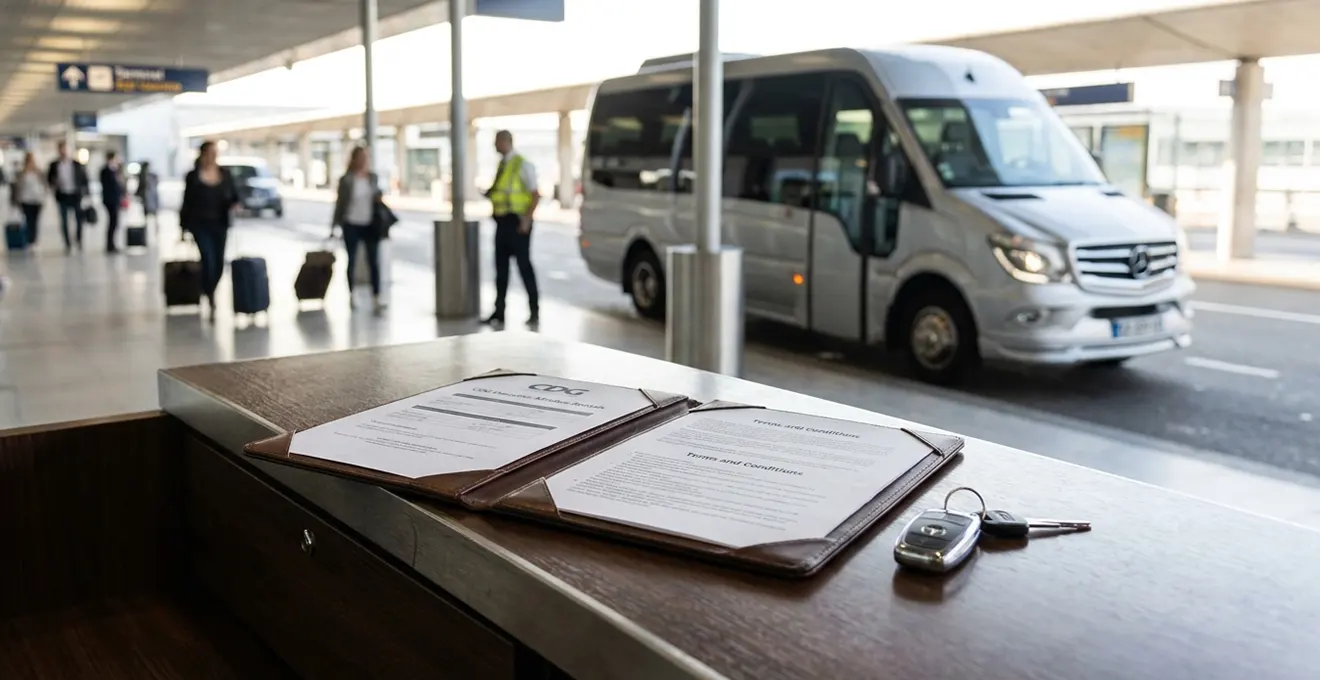
This guide walks you through the exact paperwork that unlocks your minibus keys, the contract clauses that genuinely affect your journey, and the handover sequence that determines whether your group departs on schedule.
Required documents for CDG minibus rental collection
UK photocard licences remain fully valid in France for tourism purposes — confirmed by Service-Public.fr, which specifies that pre-2021 UK licences retain their entitlement without requiring an International Driving Permit. Your licence must show Category B entitlement and remain valid for at least one year beyond your rental end date.
The second essential piece centres on payment card specifications. The European Consumer Centre France makes the distinction clear: rental companies require a credit card in the primary driver’s name because debit cards cannot support the extended pre-authorisation window. Agencies hold between 1,000 € and 2,000 € in your account for the deposit — a sum that remains frozen but not debited unless damage occurs.
Your passport or national identity card forms the third pillar. The fourth element catches one-way airport hirers off guard: proof of return flight or onward travel. Agencies serving CDG sometimes request your booking reference to verify you’re not establishing residence, a distinction that affects insurance validity.
- UK photocard driving licence — verify Category B entitlement visible, minimum 1-year validity remaining beyond rental end date
- Credit card with embossed numbers in main driver’s name — confirm card type is CREDIT not debit, available balance covers €800-1,500 deposit hold
- Valid passport or national ID card — ensure document validity covers entire rental period
- Proof of return flight or accommodation address — keep booking confirmation accessible on phone, particularly critical for one-way airport collections
Beyond the paperwork, choosing a conveniently located provider ensures a seamless transition from the airport terminal to the road. Opting for a professional minibus hire branch in Paris-Nord allows groups to benefit from local expertise and streamlined collection processes tailored to international arrivals. This strategic choice simplifies the logistical handover, providing a direct link between the arrival gate and a high-quality fleet of passenger vans designed for group travel requirements.
Rental terms decoded: the clauses that actually affect your journey
French rental contracts include standard Collision Damage Waiver (CDW) coverage, yet terminology creates confusion. The CDW limits your liability for vehicle damage to a specified excess — typically between €800 and €1,500 for a 9-seater minibus. This excess represents the maximum you’ll pay per incident, not a deductible applied to every claim.
The deposit hold mechanism causes more post-rental disputes than any other contract element. The agency places a temporary hold on your credit card — the amount appears as “pending” but hasn’t left your account. This hold remains in place for seven to ten days after you return the vehicle, at which point the funds become available again. If damage is identified, they convert part or all of that hold into an actual charge.
| Scenario | What happens to your card | When funds become available again |
|---|---|---|
| Standard rental (no damage) | €800-1,500 authorisation hold appears as ‘pending’ transaction — NOT a charge | Hold released 7-10 days after vehicle return |
| Damage claimed by agency | Authorisation converted to actual charge for damage amount, you receive itemised invoice | Charge processes within 3-5 days, unused deposit portion released 7-10 days after |
| Fuel policy violation | Separate charge for refuelling cost plus service fee (€20-40) | Charge immediate at return, deposit hold still released on normal schedule |
Fuel policies follow full-to-full principle: you collect with a full tank and return it full. Mileage terms vary — some agencies include unlimited kilometres, whilst others cap daily distance at 250 kilometres with per-kilometre charges beyond that threshold.
Damage liability extends beyond obvious collision scenarios. Contracts define your responsibility for interior staining, missing equipment, and undercarriage damage. The clause that catches business groups off guard specifies that only registered drivers are covered — if your colleague takes the wheel without prior declaration, the insurance becomes void.
When multiple drivers share the wheel: documentation that multiplies
Registering additional drivers transforms from optional convenience to legal necessity when planning shift-based driving across France. Each driver must present their own valid photocard licence at collection for the agent to verify entitlement. Agencies refuse to add drivers retrospectively once you’ve departed — the insurance underwriter requires verification before the vehicle leaves the parking zone.
Age-based surcharges appear at the desk for drivers under 25 years old, typically adding €15-25 per day to your total cost. This fee rarely features in online booking summaries. Registering all drivers during the booking process rather than at collection often reduces or eliminates these fees through promotional packages.
Young driver surcharge: the fee that appears at the desk
If any additional driver is under 25 years old, expect a daily surcharge (typically €15-25/day) applied at collection. Register young drivers during booking to receive accurate total cost upfront and verify whether your rental provider offers bundled multi-driver rates that waive age-based fees.
Family groups face a different scenario: spouses and adult children travelling together usually qualify for free additional driver registration. Business colleagues and friends generally incur per-driver fees unless you’re booking through corporate rates that include multiple drivers as standard.
Your CDG handover: what happens in the first 10 minutes
The desk-to-departure sequence follows a fixed choreography: document verification, digital contract signature, key handover, and walk-around inspection. Agents cross-reference your photocard licence against the booking name whilst processing your credit card authorisation. The payment terminal displays the exact hold amount — typically between €800 and €1,500 — which you authorise but don’t pay.
Digital signature pads have replaced paper contracts at most major desks, displaying French-language terms with an English summary available on request. Agents highlight the fuel policy, damage excess, and mileage limits before asking you to sign. Counter staff then hand over physical keys plus a vehicle condition report noting existing scratches and dents.
The walk-around inspection determines whether you’ll contest damage charges three weeks later or accept them without argument. Agents accompany you to the parking zone, pointing out pre-existing marks whilst you photograph all four sides of the vehicle, close-ups of any scratches, and the fuel gauge reading. Time-stamped photos from your smartphone create indisputable evidence — the European Consumer Centres Network reports that over 20% of rental dispute cases involved contested damage allegations, many of which hinged on whether the customer could prove the mark existed before collection.
Out-of-hours collection procedures apply when your flight lands outside desk operating times. Most agencies serving CDG offer secure lockbox key retrieval with SMS instructions, though this service requires advance arrangement during booking.
Can I use Apple Pay or Google Pay instead of presenting my physical credit card?
Rental desks require physical card presentation for deposit authorisation — digital wallets cannot process the extended hold that agencies need. Ensure you carry the physical card that matches your driving licence name.
Should I photograph existing damage before driving away?
Absolutely. Invest three to five minutes photographing all four sides of the vehicle, close-ups of any existing scratches noted on the condition report, and the fuel gauge reading. Time-stamped photos create indisputable evidence of pre-existing condition and protect against disputed damage charges.
What if my flight is delayed and I arrive outside rental desk hours?
Contact the rental agency as soon as you know about the delay. Most CDG providers offer after-hours key collection via secure lockbox with detailed instructions sent by SMS or email. This service requires advance arrangement during booking — confirm out-of-hours procedures when making your reservation.
Can I add my colleague as an additional driver when we collect the minibus?
Policies vary by agency, but many refuse on-site driver additions due to insurance verification requirements. To avoid rejection or high desk fees (typically €40-60), register all intended drivers during the online booking process when it’s often free or significantly cheaper. Your colleague must present their own valid photocard licence for verification.
Airport delivery services eliminate the traditional shuttle-bus transfer to off-site depots that can add 30-40 minutes to your collection time. Providers offering terminal-side handover meet you directly in the arrivals hall, a convenience that matters significantly when coordinating a group of eight people with luggage.
Once documentation clears and the inspection concludes, departure formalities take seconds. Agents confirm your return date and location, provide a 24-hour emergency contact number, and release you to load luggage. The entire desk-to-departure sequence, when properly prepared, completes within ten to twelve minutes — or stretches to forty minutes when documents require verification calls to head office.
Airport rental success hinges on precise preparation: the correct documentation format, clear understanding of contract mechanics, proper driver registration, and evidence-gathering discipline during handover. Arriving with photocard licence, embossed credit card, return flight confirmation, and pre-registered additional drivers positions you in the minority who collect keys within ten minutes and depart without complications — precisely the smooth professional process your group deserves.